Formula Ford 1600: UK Championships Guide
Formula Ford 1600 is the UK's classic entry-level single-seater class: wingless cars with the 1600cc Ford Kent engine and Avon control tyres. It runs in several championships, led by MSVR's United Formula Ford, the BRSCC Super Classic Pre '99 series, the Castle Combe FF1600 Championship and HSCC Historic Formula Ford, with the Formula Ford Festival and Walter Hayes Trophy as the big end-of-season events. BRSCC Super Classic registration was £125 in 2026.
This guide covers the car, the championships that run it, the 2026 calendar, the ways in, published costs, how to get started and the paddock kit a single-seater racer needs. Planning a Formula Ford season? Talk to the team about your paddock setup.
Formula Ford 1600 Facts
| Item | Detail |
|---|---|
| Class | Formula Ford 1600, also called FF1600 or Kent Formula Ford |
| Engine | 1600cc Ford Kent, built to Ford Formula Ford regulations |
| Main championships | United Formula Ford (MSVR), Super Classic Pre '99 (BRSCC), Castle Combe FF1600 (CCRC), Historic Formula Ford (HSCC) |
| Big events | Formula Ford Festival at Brands Hatch Indy and Walter Hayes Trophy at Silverstone, both in October and November |
| Tyres | Avon ACB10, with ACB9 allowed for older cars |
| Minimum weight | 500kg with the driver, in the BRSCC and Castle Combe 2026 rules |
| Published costs | £125 BRSCC Super Classic registration and £365 Castle Combe entry per event, both 2026 |
| Licence | Motorsport UK race licence; Competition Race Club grade or higher for BRSCC Super Classic in 2026. See how to get a racing licence |
What Is Formula Ford 1600?
Formula Ford 1600 is a single-seater class created in 1967 for wingless cars powered by the Ford Kent engine. With no aerodynamic aids, grip comes from the chassis, suspension and tyres, so car control and racecraft decide results.
- No wings. The cars rely on mechanical grip from the chassis, suspension and tyres.
- One engine family. Every car uses the 1600cc Ford Kent engine, built to Ford's Formula Ford regulations for its year.
- Classes by age. Each championship splits the grid by chassis build year, so an older car can still race for a class win.
- Long history. Castle Combe has run a Formula Ford championship since 1969, which the circuit club calls the oldest in the country.
- Big events. The Formula Ford Festival has run since 1972, at Brands Hatch since 1976, and in 2026 Jason Smyth became its first back-to-back winner.
Who Formula Ford 1600 Suits
Formula Ford suits drivers who want proper single-seater racing on a club budget, from first-season novices to historic car owners. The class rules let an older chassis race in its own class, so you can start with an affordable car and still fight for results. The Festival and the Walter Hayes Trophy give every FF1600 driver a shot at a famous end-of-season event, whichever championship they race in.
What Car Do You Race in Formula Ford 1600?
You race a wingless single-seater chassis with the 1600cc Ford Kent engine, built to the Ford regulations for its year of manufacture. Popular chassis include Van Diemen, Swift, Reynard and Merlyn, and the BRSCC and Castle Combe rules set a 500kg minimum weight with the driver.
| Spec | Detail |
|---|---|
| Engine | 1600cc Ford Kent, to the Ford Formula Ford regulations for the car's year |
| Aerodynamics | None. No wings or aero aids |
| Tyres | Avon ACB10, or ACB9 on older cars, in complete sets. Castle Combe also allows approved Dunlops on pre-1982 cars |
| Tyre limits, 2026 | BRSCC: up to 4 new tyres per event. Castle Combe: up to 4 new sets for the season |
| Minimum weight | 500kg car and driver (BRSCC and Castle Combe 2026) |
| Classes | Set by chassis build year in every championship |
| Typical chassis | Van Diemen, Swift, Reynard, Merlyn, Spectrum and Ray, all on recent results sheets |
Each championship publishes its own technical regulations alongside the Ford FF1600 Kent rules. Check the class your chassis falls into, and the tyre rules for that series, before you buy.
How Does a Formula Ford 1600 Race Weekend Work?
Most Formula Ford meetings are a qualifying session followed by two or three short sprint races. At Castle Combe in 2026, that meant 15 minutes of qualifying and two 15-minute races per date.
- United Formula Ford (MSVR, run with James Beckett Motorsport) ran eight rounds in 2026, with Star, Regional, Heritage, Classic and Historic classes by build year.
- The BRSCC Super Classic Pre '99 series is for Kent cars built up to 1998, in classes SCA to SCD. Its 2026 season had 13 races over six meetings, and the race 2 grid comes from the race 1 result.
- Castle Combe FF1600 runs only at Castle Combe, with Classes A to D by build year and race 2 gridded on each driver's second-fastest qualifying lap.
- HSCC Historic Formula Ford is for cars built and raced before the end of 1971, with Novice and Over 50s categories. Its 2026 meetings were Snetterton, Donington Park, Cadwell Park, Brands Hatch GP, Castle Combe, Oulton Park and Silverstone.
- The Formula Ford Festival runs heats on Saturday, then semi-finals, a Last Chance race and the Grand Final on Sunday. The Walter Hayes Trophy takes over 100 drivers through heats and knockouts to a 36-car Grand Final.
2026 calendar (2027 dates not yet published)
| Date | Circuit | Races |
|---|---|---|
| 4 April | Silverstone National | United FFord, Jim Walsh Trophy |
| 6 April to 3 October | Castle Combe, six dates | Castle Combe FF1600, 2 races per date |
| 12 April | Brands Hatch Indy | Super Classic, 2 races |
| 9 May | Oulton Park International | Super Classic, 2 races |
| 23 May | Oulton Park International | United FFord |
| 6 June | Mallory Park | United FFord |
| 13 to 14 June | Silverstone National | Super Classic, 3 races |
| 27 June | Lydden Hill | United FFord |
| 18 to 19 July | Donington Park National | Super Classic, 2 races |
| 25 July | Snetterton | United FFord |
| 22 August | Brands Hatch Indy | United FFord, Peter Rogers Trophy |
| 22 August | Snetterton 200 | Super Classic, 2 races |
| 12 to 13 September | Anglesey International | Super Classic, 2 races |
| 26 September | Kirkistown | United FFord, Martin Donnelly Trophy |
| 10 October | Silverstone National | United FFord finale |
| 24 to 25 October | Brands Hatch Indy | Formula Ford Festival |
| 31 October to 1 November | Silverstone | Walter Hayes Trophy |
These are the 2026 dates published by MSVR, the BRSCC, Castle Combe Racing Club and Silverstone. MSVR lists 2027 as TBA and the BRSCC lists its 2027 Super Classic calendar as TBC, so check each organiser before you plan next season.
How Can You Get Into Formula Ford 1600?
You can buy a used FF1600 and run it yourself, buy a car and have a team run it, or race an older chassis in a historic or classic class. Running your own car is the cheapest route for anyone with the time and a trailer.
Buy and run your own
Buy a used Kent-engined car and run it yourself or with friends.
- Pick a championship whose classes suit your chassis age.
- Check the car against that series' technical rules before you pay.
- Older chassis compete for their own class wins.
Team-run car
Pay a team to prepare and run your car, or hire one of theirs.
- United FFord front-runners in 2026 included Team Dolan and Ammonite Motorsport cars.
- The team handles set-up, tyres and the engine.
- Ask teams directly about seat prices, as none are published.
Historic and classic
Race a pre-1972 car with the HSCC or a pre-1999 car in Super Classic.
- HSCC Historic FF has a Novice class for drivers new to racing.
- Super Classic splits pre-1999 cars into four age classes.
- The Festival accepts any Kent-engined chassis, whatever its age.
How Much Does Formula Ford 1600 Cost?
The published 2026 fees are £125 to register for the BRSCC Super Classic Pre '99 championship and £365 per event to enter the Castle Combe FF1600 Championship. MSVR, the HSCC and the Festival publish entry fees on their entry forms, and car prices depend on chassis age and condition.
| Item | Cost |
|---|---|
| Super Classic Pre '99 registration, 2026 | £125 (BRSCC) |
| Super Classic guest entry fee, 2026 | £45 per round for unregistered guest drivers (BRSCC) |
| Castle Combe FF1600 entry, 2026 | £365 per event (Castle Combe Racing Club) |
| United FFord entry | Set on the MSVR entry form for each round |
| Formula Ford Festival entry, 2026 | Listed as TBC by the BRSCC |
| Race licence | See the racing licence guide |
What registration and entry cover
- Championship registration: eligibility for points and class awards
- Event entry: qualifying and races at that meeting
- Club membership is required too: BRSCC for Super Classic, Castle Combe Racing Club for the Combe series
Costs to add
- The car, its Kent engine rebuilds and spares
- Avon control tyres, within each series' tyre limit
- Race kit: helmet, FHR device, suit, boots and gloves
- Club membership, fuel, travel and a paddock setup
Fees change every season. Check the organiser's current regulations and entry forms before you budget, and ask sellers for the car's engine rebuild history.
How Do You Start Racing in Formula Ford 1600?
Get a race licence, choose a championship that suits your car's age and your nearest circuits, join the organising club, then buy or hire a car. The BRSCC set a Competition Race Club licence as the minimum for Super Classic in 2026.
- Get your race licence. You need the Motorsport UK starter pack, the ARDS test and, for most people, a medical.
- Choose a championship: United FFord for national rounds, Super Classic for pre-1999 cars, Castle Combe for one venue, or the HSCC for pre-1972 cars.
- Join the organising club and register for the championship.
- Buy a car that fits a class, or talk to a team about running one for you.
- Book a test day at your first circuit, then enter the opening round.
What Paddock Kit Do You Need for Formula Ford Racing?
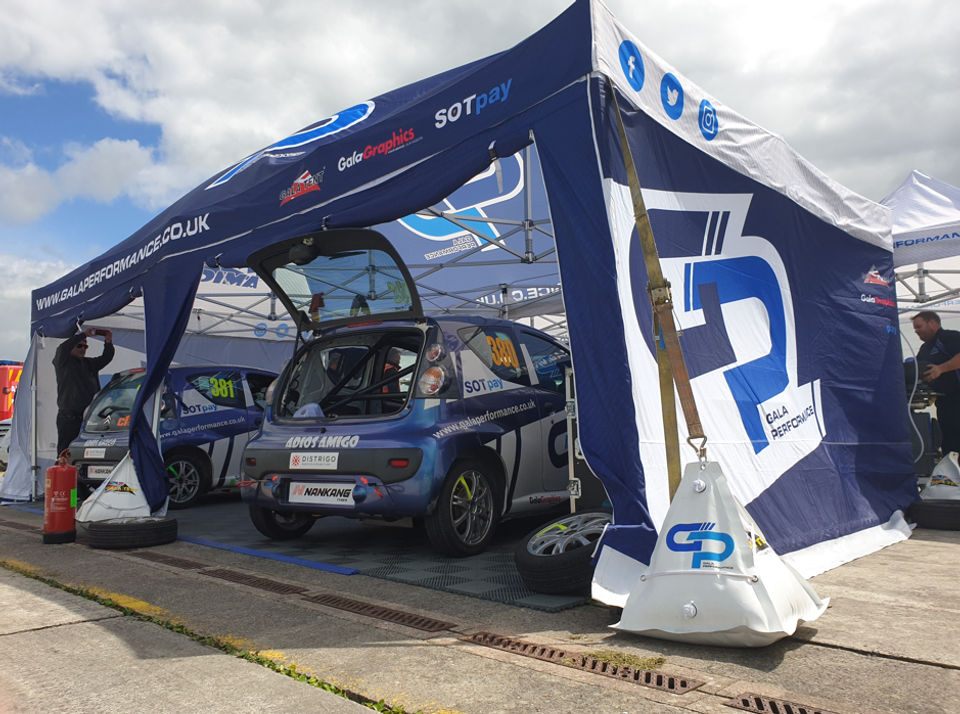
A Formula Ford racer needs a compact, weatherproof base for a sprint race day: a pop up race tent weighted down, side walls for wind and rain, and space for the car, tyres and tools. The Festival and the Walter Hayes Trophy run in late October and November, so plan for cold, wet weekends.
- A pop up race tent big enough for the car with room to work round it. The size guide helps you choose.
- Race tent weights on every leg. Most calendar circuits have tarmac paddocks where pegs are banned.
- Side walls to keep wind and rain off the car at the autumn events.
- Space for tyre sets, a trolley jack and a set-up area, as the grid moves fast between qualifying and races.
- A heavy duty awning if you share a base with other drivers or a team.
- Branded tents and walls to look after your sponsors. See how to get sponsored.
Formula Ford 1600 FAQs
How much does it cost to race Formula Ford 1600?
What engine does a Formula Ford 1600 use?
What licence do you need for Formula Ford?
Can you race an old Formula Ford?
When is the Formula Ford Festival?
Which Formula Ford championship should I enter?
Formula Ford 1600 Circuit Guides
Layouts, paddock rules, facilities and directions for each circuit on the calendar.