Race Trailer Awnings: Wind-Out or Freestanding?
A race trailer awning is any awning used to make covered working space beside a race trailer or transporter. There are two types: a wind-out awning that bolts to the side of the vehicle, and a freestanding awning pitched alongside it. For most race teams a freestanding awning is the better choice, because it gives a full weatherproof working bay you can pitch wherever the paddock allows.
Gala Performance builds freestanding pop up race tents and MQ-65 heavy-duty awnings. Want help matching one to your trailer? Talk to the team.
Wind-Out vs Freestanding at a Glance
| Wind-out (vehicle-mounted) | Freestanding (pitched alongside) | |
|---|---|---|
| What it is | An awning that bolts to the trailer or truck and winds or rolls out | A separate pop up or MQ-65 awning pitched beside the trailer |
| Cover | A strip down one side of the vehicle | A full working bay, from 3m x 3m up to 6m x 12m |
| Best for | Quick shade at the truck door | Working on the car or bike out of the weather |
| Made by Gala Performance | No | Yes |
What Is a Race Trailer Awning?
A race trailer awning is a shelter that gives a race team covered space next to its trailer or transporter. The term covers two different products: vehicle-mounted wind-out awnings and freestanding paddock awnings.
Vehicle-mounted wind-out awnings
A wind-out awning bolts to the side of a race transporter or trailer and winds or rolls out, in the same way as the awnings fitted to motorhomes and commercial vans. It is quick and tidy to deploy. It is also fixed to the vehicle, so its size is limited, its position depends on where and how the truck is parked, and it covers a strip down one side only.
Gala Performance does not make vehicle-mounted awnings. If that is the type you want, a motorhome or commercial-vehicle awning specialist is the place to go.
Freestanding paddock awnings
A freestanding awning is a separate structure you pitch next to, or behind, your trailer to create an enclosed working bay. This is the type Gala Performance builds, as pop up race tents and MQ-65 heavy-duty motorsport awnings.
Why freestanding works better in the paddock
A vehicle-mounted awning gives you a strip of shade down one side of the truck. A freestanding awning gives you a workshop:
- More space. A proper bay for the car or bike, tools, tyres and crew.
- A weatherproof workshop. Side walls, a full roof and somewhere dry to work.
- Freedom to pitch. Put it wherever the paddock space allows, whatever the parking or the shape of your pitch.
- It scales. Cover one car or a whole team, and link two awnings with a gutter kit to build a bigger compound.
- It works without a trailer. If you travel in a van one weekend, you are still covered.
Wind-Out Awning vs Pop Up vs MQ-65: Which Gives Better Cover?
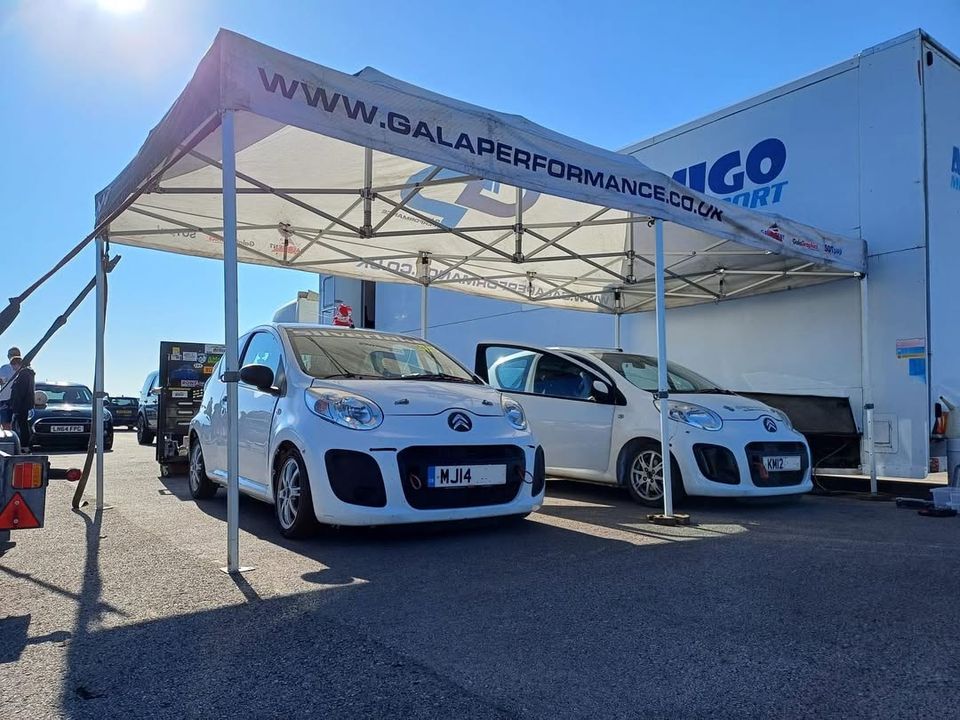
A freestanding awning gives far more cover than a wind-out trailer awning. A pop up race tent pitched beside the trailer gives a full bay for one car or bike, and an MQ-65 freestanding awning gives a clear-span compound of up to 6m x 12m for a team.
| Factor | Wind-out (vehicle-mounted) | Pop up race tent | MQ-65 awning |
|---|---|---|---|
| Cover area | A strip down one side of the vehicle; size limited by the truck | Pro 50: 3x3, 3x4.5, 3x6, 4x6, 4x8. Pro 60: 3x3, 3x6, 4x8, 4x10 and 6x6 Vantage | 4x6, 4x8, 6x8, 6x12, clear span with no internal legs |
| Wind | Set by the awning maker; check their rating | Pro 50 and Pro 60 rated 25 to 35 mph when weighted or anchored on every leg | 50 mph plus with 2 to 3 weights per leg |
| Set-up | Winds out from the vehicle; quick and tidy | Frame unfolds in one piece; quick to pitch after a long drive | Sturdier build suited to semi-permanent setups; made to order, typically 6 to 8 weeks |
| Walls and weather | Depends on the product | Optional side walls; 600D canopy with 6000mm hydrostatic head on Pro 50 and Pro 60 | 650gsm PVC covers; options include windows, hard doors and curtain walls |
| Flexibility | Fixed to the vehicle and to how it is parked | Pitch wherever the space allows; works with a van or with no trailer at all | Pitch anywhere; sizes up to 6m x 12m for a full team compound |
| Branding | Depends on the product | Printed canopies and side walls in team livery | Plain white or fully printed |
Sizes are in metres. Wind ratings for Gala Performance products apply only when every leg is weighted or anchored as stated. We do not publish figures for vehicle-mounted awnings because we do not make them. For a fuller look at frames and covers, see how to choose a motorsport awning.
How Do You Set Up an Awning Next to a Race Trailer?
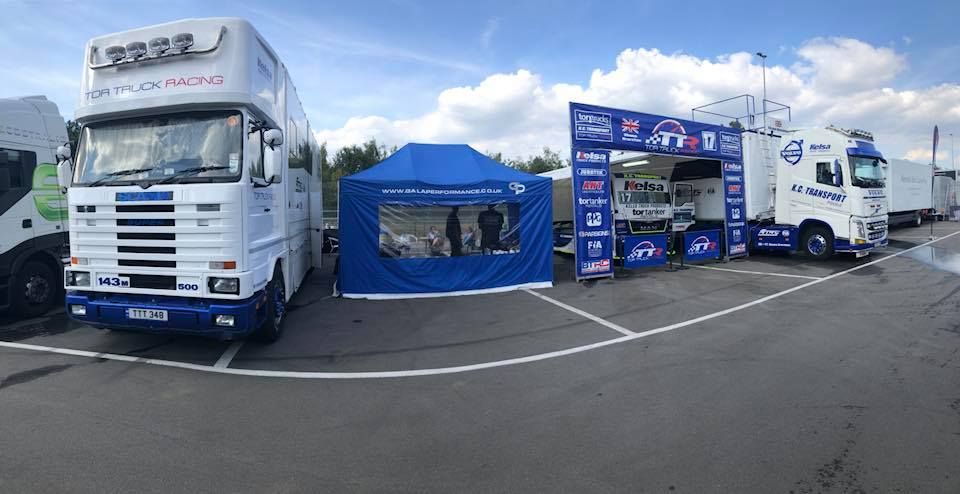
Pitch the awning off the side or the rear of the trailer so the two form a sheltered run between them. You step straight from the transporter into a dry working bay, and the trailer acts as one solid wall against the wind.
- Park first, then pitch. Set the trailer where you want it, then measure the space left on your pitch before you open the awning.
- Put the trailer on the windward side where you can. It blocks the worst of the weather from the working bay.
- Leave a walkway. A gap of around a metre lets you move between trailer and awning without tripping on legs or weights.
- Face the open side away from the wind. Fit side walls to the exposed ends and keep the open front where you load the car.
- Weight every leg. A trailer alongside can channel wind into the structure, so anchor for the surface every time.
For one car, a 3m x 4.5m or 3m x 6m Pro 50 alongside the trailer gives room to work with the car out of the weather. Our motorsport tent size guide draws more vehicle layouts to scale.
Which Freestanding Awning Suits a Race Trailer?
For one car or bike run from a trailer, a pop up race tent in 3m x 4.5m or 3m x 6m is the usual choice. For a team, more than one vehicle or a semi-permanent base, an MQ-65 freestanding awning in sizes up to 6m x 12m turns the space beside the transporter into a full race compound.
Pop up race tents
Pop ups are quick to pitch after a long drive and easy to pack down. The Pro 50 has a 50mm hexagonal aluminium frame and is the heavy-duty all-rounder. The Pro 60 is the flagship, on a 60mm hexagonal aluminium frame with double-reinforced truss joints, and it is the UK's only 60mm pop up. The Pro 40 is the lightweight range on a 40mm frame, suited to karting, bikes and track days.
MQ-65 freestanding awnings
The MQ-65 is built on a 65mm T6061/T6 aluminium frame with a 2.5mm wall and 650gsm PVC covers that slide into the frame. It is clear span, so there are no internal legs to work around, and it comes in 4x6, 4x8, 6x8 and 6x12. Each is made to order, typically in 6 to 8 weeks, so order well before the season.
Branding
Both types can be printed in your team and sponsor livery, so the transporter and awning present as one unit. See branded motorsport tents for options.
How Do You Anchor an Awning Beside a Trailer?
Anchor every leg of a trailer-side awning, every time. On soft ground use a tie-down storm kit, and on hard standing use heavy-duty race tent weights on every leg.
Paddocks funnel wind, and the gap between a trailer and an awning can speed it up further. The trailer helps on the side it shelters, and the open ends need the most attention.
- Pro 50 and Pro 60 pop ups are rated 25 to 35 mph only when securely weighted or anchored on every leg.
- MQ-65 awnings are rated 50 mph plus with 2 to 3 weights per leg.
- Side walls on the exposed ends stop gusts getting under the canopy.
- If the wind goes beyond the rating, take the awning down.
Not sure what suits your rig? Request a callback and we will talk it through.

Race Trailer Awning FAQs
What is a race trailer awning?
Can you get an awning that attaches to a race trailer?
Is a freestanding awning better than a wind-out trailer awning?
What size awning do I need beside a race trailer?
How do I stop an awning next to a trailer blowing away?
How do you set up an awning next to a trailer?
Can I use a freestanding awning without a trailer?
Get Cover Sorted Beside Your Trailer
Tell us what you race, the size of your trailer or transporter and the pitches you usually get. The team will recommend an awning, size, walls and weights to suit.